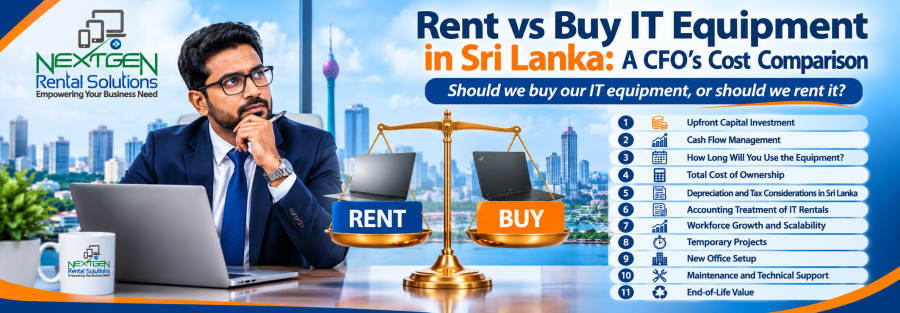
Rent vs Buy IT Equipment in Sri Lanka: A CFO’s Cost Comparison

For a Chief Financial Officer (CFO), purchasing IT equipment is not simply an IT decision. It is a financial decision that affects cash flow, capital expenditure, asset management, depreciation, maintenance costs and long-term business flexibility. As businesses in Sri Lanka expand, many companies are asking an important question: Should we buy our IT equipment, or should we rent it? The answer depends on the company’s workforce, budget, expected equipment usage, project duration and long-term IT strategy. For some businesses, purchasing laptops and other equipment may make sense. For others, IT equipment rental can provide greater flexibility and help reduce the need for a large upfront investment. This guide explains the key financial factors Sri Lankan CFOs and finance teams should consider when comparing renting vs buying IT equipment. What Does IT Equipment Rental Mean? IT equipment rental allows a business to use computers and other technology equipment for an agreed period in exchange for a rental payment. Depending on the provider and agreement, businesses may rent:
  • Business laptops
  • Desktop computers
  • Tablets
  • Monitors
  • Projectors
  • Printers
  • Networking equipment
  • Conference equipment
  • Other IT accessories
Rental periods can be daily, weekly, monthly or longer, depending on the provider and business requirement. For example, a company opening a temporary project office in Colombo may require 30 laptops for six months. Instead of purchasing 30 laptops, the company can evaluate whether renting them for the project period is more appropriate. What Does Buying IT Equipment Mean? When a company purchases IT equipment, the company owns the assets. The business is then responsible for managing those assets throughout their useful life, including:
  • Asset registration
  • Maintenance
  • Repairs
  • Upgrades
  • Warranty management
  • Replacement
  • Security
  • Disposal
  • Resale
For businesses expecting to use the same equipment for several years, ownership can be a practical approach. However, ownership also means committing capital and accepting the responsibilities associated with the assets. Rent vs Buy: The CFO’s Main Considerations A CFO should avoid comparing only the purchase price with the monthly rental price. A more meaningful comparison is: Total Cost of Ownership vs Total Cost of Rental The analysis should consider the complete financial and operational lifecycle of the equipment. Important factors include:
  1. Initial investment
  2. Monthly cash flow
  3. Equipment usage period
  4. Maintenance
  5. Repairs
  6. Depreciation and tax treatment
  7. Asset management
  8. Hardware upgrades
  9. Replacement costs
  10. Residual value
  11. Financing costs
  12. Flexibility
  1. Upfront Capital Investment
One of the most obvious differences between buying and renting is the initial cash requirement. Imagine a company needs 50 business laptops. Assume, purely for illustration, that each laptop costs: LKR 200,000 The purchase cost would be: 50 × LKR 200,000 = LKR 10,000,000 The company would therefore commit LKR 10 million to the equipment purchase before considering accessories, software, maintenance or other related expenses. A rental model can structure the expenditure differently by spreading payments over the rental period. For a CFO, the question becomes: Is it preferable to invest LKR 10 million in IT assets immediately, or retain that capital for other business purposes?
  1. Cash Flow Management
Cash flow is particularly important for growing companies. A large IT purchase can create a significant one-time cash requirement. By contrast, a rental agreement generally spreads payments over the period of use. This may allow a company to preserve capital for:
  • Working capital
  • Inventory
  • Recruitment
  • Marketing
  • Business expansion
  • Office infrastructure
  • Debt servicing
  • Other investments
The financial value of retaining capital should therefore be considered when comparing rental and ownership.
  1. How Long Will You Use the Equipment?
The expected usage period is one of the most important factors in a rent-versus-buy analysis. Buying may be considered when:
  • The equipment will be used for several years.
  • The workforce is stable.
  • The specifications will remain suitable.
  • The company wants permanent ownership.
  • The company has sufficient capital.
Renting may be considered when:
  • Equipment is required temporarily.
  • The business is rapidly expanding.
  • Employees are hired for projects.
  • A new office is temporary.
  • Equipment is required for an event.
  • A company needs additional equipment for a specific period.
The longer the company expects to use an asset, the more important it becomes to calculate its complete ownership cost.
  1. Total Cost of Ownership
The purchase price is only one part of the cost of owning IT equipment. A CFO should consider: Purchase Price + Maintenance + Repairs + Upgrades + IT Administration + Replacement − Residual Value For example, a laptop purchased for LKR 200,000 does not necessarily represent a total business cost of only LKR 200,000. Over its useful life, the company may also incur costs for:
  • Repairs
  • Batteries
  • SSD upgrades
  • RAM upgrades
  • Accessories
  • IT support
  • Warranty extensions
  • Asset management
  • Secure disposal
These costs should be included when comparing ownership with rental.
  1. Depreciation and Tax Considerations in Sri Lanka
Tax treatment is an important consideration for finance teams. Sri Lanka’s Inland Revenue Act classifies computers and data-handling equipment together with peripheral devices as Class 1 depreciable assets. Capital allowances are provided under the relevant provisions for qualifying depreciable assets owned and used in the production of business income. This means a company purchasing qualifying IT equipment should consider the applicable capital allowance rules when calculating the after-tax economics of ownership. The tax treatment of rental payments and the accounting treatment of a particular rental or lease agreement can depend on the exact contract and circumstances. Companies should therefore have their accountant or tax adviser review the specific arrangement before making a major procurement decision.
  1. Accounting Treatment of IT Rentals
The accounting treatment of an IT rental arrangement should not be assumed simply from the fact that payments are made monthly. Sri Lanka uses applicable Sri Lanka Accounting Standards, including SLFRS 16 for leases where applicable. The precise accounting treatment depends on the nature and terms of the arrangement. For CFOs, this means the finance team should review:
  • Contract duration
  • Right-of-use considerations
  • Renewal options
  • Termination clauses
  • Payment structure
  • Identified assets
  • Service components
  • Applicable accounting standards
The rental provider’s invoice structure alone does not determine the accounting treatment.
  1. Hardware Depreciation and Obsolescence
Technology changes quickly. A laptop purchased today may become less suitable for certain workloads several years later. Companies purchasing large numbers of laptops need to plan:
  • Hardware refresh cycles
  • Performance requirements
  • Replacement schedules
  • Asset disposal
  • Resale
For businesses with rapidly changing technology requirements, rental can provide another way to manage hardware refresh cycles. However, CFOs should compare the actual rental cost against the expected ownership cost rather than assuming rental is automatically cheaper.
  1. Workforce Growth and Scalability
A company may have 50 employees today and 100 employees next year. If the business purchases all equipment upfront, it may need to make another large capital investment when the workforce expands. A rental model can provide an alternative where equipment requirements are scaled according to the company’s workforce. This can be useful for:
  • Startups
  • SMEs
  • BPO companies
  • Project-based businesses
  • Outsourcing companies
  • Temporary teams
  • Companies opening new branches
  1. Temporary Projects
Not every business requirement is permanent. Consider a company that wins a six-month project requiring 30 additional employees. Those employees may each need a laptop. Purchasing 30 laptops creates a permanent asset investment even though the project is temporary. Renting can allow the company to align its IT equipment requirement with the project period. At the end of the project, the business can reassess its requirements.
  1. New Office Setup
Companies opening new offices in Colombo or other parts of Sri Lanka may need a significant amount of IT equipment. A new office may require:
  • Laptops
  • Desktops
  • Monitors
  • Printers
  • Network equipment
  • Projectors
  • Conference equipment
  • Tablets
Rather than purchasing every item immediately, a business can evaluate a combination of owned and rented equipment. For example: Permanent staff → Company-owned laptops Temporary project staff → Rented laptops Meeting room → Rented or purchased equipment This hybrid approach can provide greater flexibility.
  1. Maintenance and Technical Support
IT equipment requires maintenance throughout its useful life. When a company owns its equipment, it generally needs to manage repairs and support internally or through service providers. With a rental arrangement, the agreement may include technical assistance, maintenance or replacement services depending on the provider and contract. Before signing a rental agreement, CFOs should confirm:
  • Is technical support included?
  • What happens when a laptop fails?
  • Is replacement equipment available?
  • Who pays for repairs?
  • What happens if equipment is damaged?
  • Are chargers and accessories included?
  • What are the response times?
These details can significantly affect the actual cost of rental.
  1. End-of-Life Value
Purchased laptops may retain some value at the end of their useful business life. The company may:
  • Sell the equipment
  • Reassign it
  • Trade it in
  • Recycle it
  • Dispose of it securely
The expected residual value should be included in a proper rent-versus-buy calculation. For example: Purchase Cost: LKR 10,000,000 Estimated resale value after the usage period: LKR 2,000,000 The effective equipment cost before other ownership expenses would be: LKR 8,000,000 This is only an illustrative calculation; actual resale values vary significantly depending on model, age, condition and market demand. A Simple Sri Lankan CFO Cost Comparison Consider a hypothetical business requiring 50 laptops for 24 months. Option A – Purchase Assume: 50 laptops × LKR 200,000 = LKR 10,000,000 The CFO should then consider:
  • Maintenance
  • Repairs
  • Accessories
  • IT support
  • Upgrades
  • Asset management
  • Depreciation/capital allowances
  • Financing cost
  • Residual value
Option B – Rent The CFO would calculate: Monthly rental × Number of laptops × Number of months For example, if the rental rate were hypothetically: LKR 12,000 per laptop per month Then: 50 × LKR 12,000 × 24 = LKR 14,400,000 This simple calculation shows that the rental cost could be higher than the initial purchase price in this hypothetical example. But it is not sufficient to conclude that buying is cheaper. The purchase option needs to account for the cost of capital, maintenance, repairs, asset management and the value of the equipment at the end of the period. The rental option needs to be assessed based on what services are included in the rental agreement. The Importance of Opportunity Cost Suppose a company has LKR 10 million available. It could spend that money purchasing laptops. Alternatively, it could retain the capital and use it for:
  • Working capital
  • Inventory
  • Expansion
  • Marketing
  • New employees
  • Business development
  • Debt reduction
The financial return or cost avoided by using that capital elsewhere is the opportunity cost that should be considered in the CFO’s analysis. This is one reason why comparing only the equipment purchase price with the rental price can produce an incomplete conclusion. When Buying IT Equipment May Be Suitable Purchasing may be appropriate for businesses that:
  • Expect to use equipment for several years.
  • Have stable employee numbers.
  • Have predictable IT requirements.
  • Have sufficient capital.
  • Have internal IT support.
  • Want permanent ownership.
  • Can manage repairs and replacement cycles.
  • Expect meaningful residual value.
When Renting IT Equipment May Be Suitable Rental may be worth considering when businesses:
  • Need equipment temporarily.
  • Are rapidly expanding.
  • Have project-based employees.
  • Need laptops for contractors.
  • Are setting up temporary offices.
  • Need additional laptops for events.
  • Want to reduce a large upfront capital commitment.
  • Have fluctuating equipment requirements.
Again, the actual financial outcome depends on the rental price and contract terms. A Hybrid Approach: Rent Some, Buy Some Businesses do not necessarily need to choose only one model. A hybrid IT procurement strategy can combine ownership and rental. For example:
Requirement Possible Approach
Permanent employees Buy
Temporary employees Rent
Long-term project Compare both
Short-term project Rent
Corporate event Rent
Executive equipment Buy
Rapid workforce expansion Rent/Hybrid
Temporary office Rent/Hybrid
This approach allows the business to match the procurement method to the expected duration and purpose of each IT requirement. Questions CFOs Should Ask Before Renting IT Equipment Before signing an IT rental agreement, finance and procurement teams should ask:
  1. What is the monthly rental price?
  2. What is the minimum rental period?
  3. Is there a security deposit?
  4. Are delivery and collection included?
  5. Is technical support included?
  6. What happens if equipment fails?
  7. Is replacement equipment available?
  8. What happens if equipment is damaged?
  9. Are accessories included?
  10. Can additional laptops be added later?
  11. What happens if equipment is returned early?
  12. What are the renewal terms?
  13. How is company data handled when equipment is returned?
  14. What are the applicable taxes and charges?
  15. Does the contract require specific accounting treatment?
A detailed comparison at the beginning can prevent unexpected costs later. CFO Checklist: Rent or Buy? Before making a decision, evaluate these five areas:
  1. Cash Flow
How much capital will be required immediately?
  1. Usage Period
How long will the business actually need the equipment?
  1. Total Cost
What will the equipment cost over its complete lifecycle?
  1. Flexibility
How quickly might the company’s workforce or equipment requirements change?
  1. Asset Management
Who will manage maintenance, repairs, upgrades, replacement and disposal? A spreadsheet comparing these factors can provide a much clearer picture than comparing only the purchase price with the monthly rental fee. IT Equipment Rental in Sri Lanka Nextgen Rental Solutions (Pvt) Ltd provides flexible IT equipment rental solutions for businesses, organizations, professionals and events in Colombo and surrounding areas. Our rental solutions can support:
  • Corporate laptop requirements
  • Temporary employees
  • Project teams
  • New office setups
  • Startups and SMEs
  • Training programs
  • Conferences
  • Seminars
  • Workshops
  • Corporate events
  • Short-term projects
  • Long-term requirements
Our rental options include: Daily | Weekly | Monthly Rentals We can discuss your required number of devices, laptop specifications, rental duration and technical support requirements and provide a suitable rental proposal. Making the Right IT Procurement Decision The rent-versus-buy decision should not be based on one number. For a CFO, the more meaningful question is: What is the total economic cost of obtaining, operating, financing and eventually replacing the IT equipment? Buying can provide ownership and may make sense for stable, long-term requirements. Rental can provide flexibility for temporary projects, changing workforce requirements and businesses that want to avoid a large upfront equipment purchase. For many businesses, a combination of owned and rented IT equipment can provide a practical procurement strategy. The right decision should be based on the company’s cash-flow position, equipment usage period, workforce requirements, accounting treatment, tax considerations and long-term technology strategy. Need IT Equipment for Your Business? If your company is evaluating laptop rental or IT equipment rental in Sri Lanka, Nextgen Rental Solutions (Pvt) Ltd can discuss your requirements and provide a customized rental solution. Whether you need a single laptop, equipment for a growing team, or multiple devices for a corporate project, our team can help you evaluate your requirements. Nextgen Rental Solutions (Pvt) Ltd IT Equipment Rentals | Laptop Rentals | Corporate IT Solutions Reliable • Flexible • Affordable 📞 Call: 076 206 4286 📧 Email: sales@nextgenrentalz.com Your Reliable IT Rental Partner in Sri Lanka.

At vero eos et accusamus et iusto odio digni goikussimos ducimus qui to bonfo blanditiis praese. Ntium voluum deleniti atque.

Melbourne, Australia
(Sat - Thursday)
(10am - 05 pm)

No products in the cart.

Choose Demos Submit a Ticket Purchase Theme

Pre-Built Demos Collection

Consultio comes with a beautiful collection of modern, easily importable, and highly customizable demo layouts. Any of which can be installed via one click.

Cryptocurrency
Business Construction
Business Coach
Consulting
Immigration
Finance 2
Corporate 1
Corporate 2
Corporate 3
Consulting
Business 1
Business 2
Business 3
IT Solution
Tax Consulting
Human Resource
Life Coach
Marketing
Insurance
Finance RTL
Marketing
Consulting
Consulting
WeCreativez WhatsApp Support
Our dedicated support team is available to address all your inquiries. Feel free to ask us anything!
👋 Hello, how may I assist you today?